

Archive

Archive for August, 2012

Russia enters stagflation?

August 27th, 2012 No comments

Russian GDP contracted by 0.2% in July. In the opposite, inflation picked to 7% on the yearly basis, 1% above the government’s target.

According to Andrei Belousov, Minister of Economic Development, 6% of GDP growth is needed for social stability

New statistics demonstrate that even oil price of $114 per barrel can’t help Russian economy to grow. Within its current economic model, Russia needs not just high oil prices, but constantly growing oil prices. The reason for the July’s GDP fall was the stagnation of the net export and investments, but above all the slowdown of the households’ consumption.

To combat inflation, Central Bank of Russia might raise interest rates thus nocking the economy further down. In its turn, the increased government spending might bring nothing but the spike of inflation. Economy can be in stagflation for quite long before the government dares to break the vicious circle with the painful structural reforms.

However, the July spike in inflation could be caused by the coincidence of several temporary factors such as unusual drought, ruble’s devaluation and the utilities tariffs rise. But the GDP figure is much more serious. Most likely, the government will have to forget about forecasted 4% of economic growth, to say nothing about desired 5-6%, and fight for a mere 2%.

RIA Novosti

  • Share/Bookmark

Putin’s decisions lead to a collapse of the Russian pension system

August 20th, 2012 No comments

Putin boosts pensions at the expense of younger generations

The Russian government failed to deliver a strategy for a new pension reform, missing the deadline set by the President of Russia.

Ministers, responsible for the economic and financial policy, haven’t reached a compromise on the future of the Russian pension system. There is no easy solution to a pension crisis, since Putin has promised not to raise both the retirement age and the mandatory pension contributions while radically increasing pensions.

To resolve the current pension crisis, the government is considering to abandon the mandatory funded pension scheme, introduced only a decade ago. According to Mikhail Dmitriev, the head of The Centre for Strategic Research,  some government officials propose liquidation of non-state pension funds and spending already accumulated savings on current pensions.

The dismantling of the mandatory funded pension system will hit mainly middle class: citizens younger than 45 years with income higher than average. These people live in big cities, rarely vote and are unlikely to vote for Putin and his party anyway.

Since the Russian parliament rubber stamps all proposals of the government, there will be no public discussion of the new pension reform. Non-transparent decision making procedure as well as radical options under discussion will undermine people’s fragile trust to pension system and once again increase risks of investing in Russia.

The Center for Strategic Research

  • Share/Bookmark
Categories: Analysis, Economic impact, Russia, investment Tags:

The Russian government embraces capital outflow

August 13th, 2012 No comments

Deputy economy minister Andrei Klepach raised capital outflow estimates

Last week Ministry of Economic Development of the Russian Federation doubled its estimates for net capital outflow from Russia in 2012. The new official forecast is about $50 billion.

Huge capital outflow is not a surprise for Russian economy. The news is the officials’ tone on commenting the issue. Less than two months ago they pledged a capital inflow in the second half of 2012. Now they adopted more gloomy view on the future economic conditions. Wisely enough, the government economists don’t want to be responsible for the country’s inability to attract new investments. External conditions on the global markets and the Russia’s lack of competitiveness almost guarantee stagnation of investments in the foreseeable future.

Deputy Finance Minister Alexey Moiseev explained in his recent interview to Vedomosti, a Russian business daily, that capital outflow is a normal and even positive process. Capital outflow triggers national currency devaluation, which increases the ruble-nominated government’s incomes from export duties and improves the competitiveness of domestic business. In line with that, the Central Bank of Russia recently intervened heavily on the currency market when the ruble was gaining value, but stayed cool when the national currency was falling. In their turn, the market expectations for continuing devaluation stimulate further capital outflow.

Chicago Tribune

  • Share/Bookmark

While ConocoPhillips quits Russia, Rosneft acquires new reserves

August 4th, 2012 No comments

ConocoPhillips has put up for sale its 30% stake in Naryanmarneftegaz, a joint venture with Russian oil giant Lukoil. Meanwhile state-owned Rosneft acquired 51% in joint venture with Itera Holding, an independent natural gas producer.

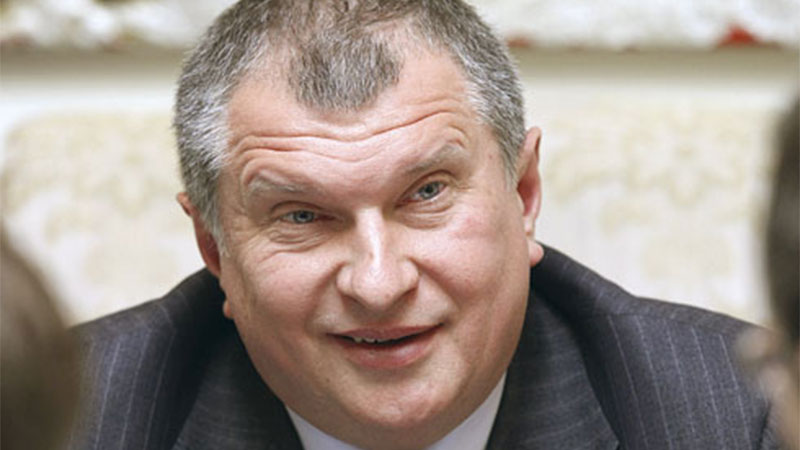
Rosneft's CEO Igor Sechin ensured state control over natural gas reserves

Previously ConocoPhillips sold its 20% stake in Lukoil. ConocoPhillips CEO Jim Mulva justified the sell-off by the gloomy business prospects for non-state owned companies, which can’t obtain any large deposits from the Russian government. International companies are invited to cooperate only with state-owned Gazprom and Rosneft.

The latter once again increased its huge reserves, this time by forming a joint venture with independent natural gas producer Itera Holding. The newly acquired reserves will allow Rosneft to become the third largest natural gas producer in Russia.

These two recent events fit well into a bigger trend of growing state participation in the Russian oil and gas industry, coincided with the anemic growth of the industry in the last eight years. Restricting private initiative within the sector, as well as limiting the industry’s access to the international capital markets and best technologies will likely to result in the stagnation of the oil and natural gas sector and the Russian economy as a whole.

The Wall Street Journal

Russia Beyond the Headlines

  • Share/Bookmark